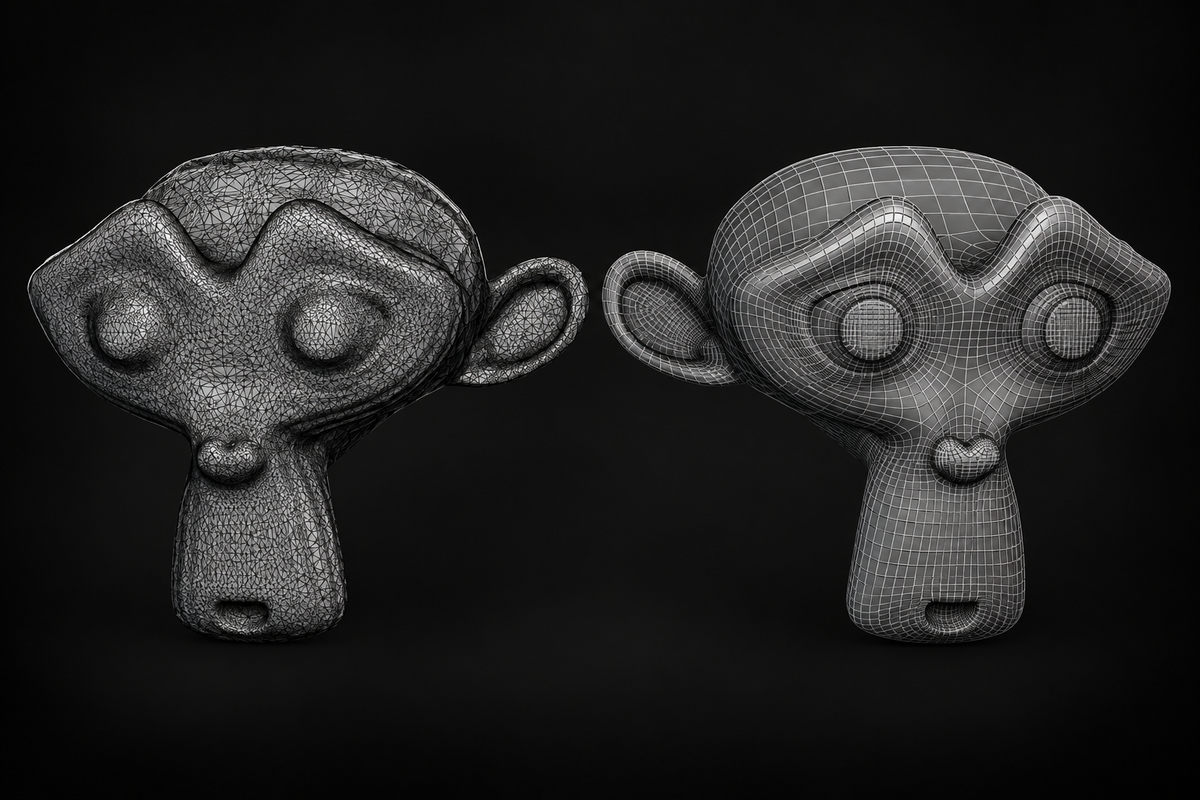
Retopology

Retopology is the process of rebuilding the surface mesh of a 3D model with cleaner, more efficient polygon topology - converting dense, irregular scans or sculpts into production-ready meshes with proper edge flow, UVs, and controllable polygon count.

Raw 3D captures (photogrammetry, sculpts, 3DGS-to-mesh conversions) produce meshes with millions of irregularly distributed triangles. These are unusable in production workflows that require predictable polygon budgets, proper edge loops for animation, clean UV layouts for texturing, and manifold geometry for physics simulation.

Manual retopology is one of the most tedious tasks in 3D production - an artist painstakingly redraws the surface topology, often taking hours per asset. Automated methods using voxel remeshing or quadric-based decimation exist but sacrifice quality.

AI-driven retopology uses learned priors to produce topologically sound meshes that preserve anatomical features, maintain symmetry, and generate sensible UV maps. The approach combines mesh neural networks with differentiable rendering to optimise topology against the original surface.

Datameister developed Retopomeister, a prototype AI tool for automated 3D asset retopology that demonstrates practical topology-aware mesh reconstruction preserving anatomy, symmetry, and UVs.

Related Capabilities

3D Deep Learning3D Generative AI
See All Research Tracks

From the Blog

Automated Retopology for 3D Assets

Clean, anatomy-aware retopology remains a high-stakes bottleneck that existing manual, semi-automatic, and fully automatic tools only partially address. Retopomeister identifies anatomical anchor points, selects appropriate curated source topologies, and uses neural wrapping to conform that topology onto the target mesh with symmetry preservation, while allowing artists to adjust anchors and maintain creative control. By transferring production-ready metadata like UV unwraps, vertex groups, and material seams along with the topology, it reduces downstream work across the entire pipeline. The prototype system showcases promising directions: enhanced keypoints, interactive loop sketching, and a more iterative workflow.