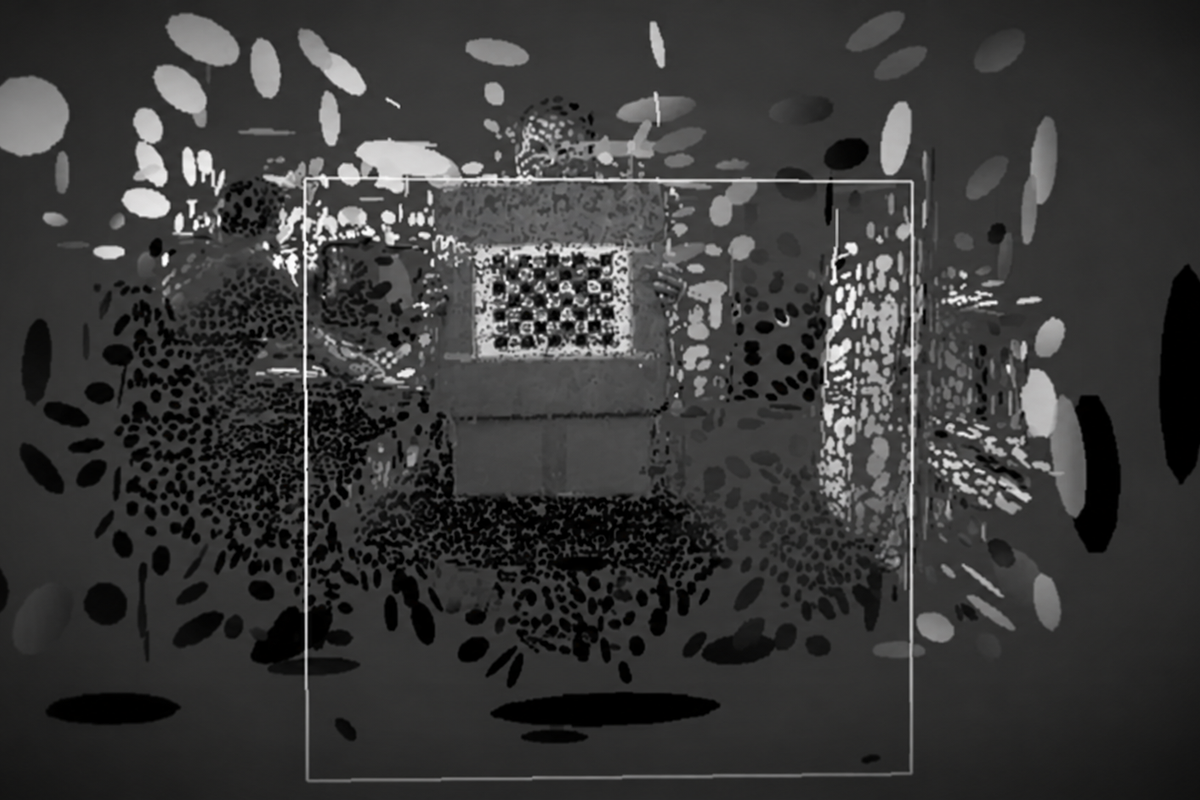
Gaussian Splatting
Gaussian splatting is a real-time 3D scene representation that models a scene as millions of small 3D Gaussian primitives, each with a position, covariance, colour, and opacity - enabling photorealistic rendering at interactive frame rates without neural network inference.
Introduced as 3D Gaussian Splatting (3DGS), the technique reconstructs a scene from multi-view images by optimising a set of anisotropic 3D Gaussians. Each Gaussian is defined by its mean (position), covariance matrix (shape and orientation), opacity, and spherical harmonics coefficients (view-dependent colour).
Rendering works by projecting ("splatting") these Gaussians onto the image plane and alpha-compositing them front-to-back. Because there is no per-pixel ray marching, rendering is orders of magnitude faster than Neural Radiance Fields (NeRFs) while achieving comparable or better visual quality.
Variants like WildGaussians handle in-the-wild captures with appearance variation, and Gaussian Frosting adds a thin shell of Gaussians on top of a mesh for hybrid mesh+splat rendering. The format is also increasingly used as an intermediate representation in 3D generative pipelines.
Datameister uses Gaussian splatting in scan-to-3D pipelines - converting point clouds and images into photorealistic reconstructions for inspection, digital twins, and media production.