
Computer Vision

Computer vision is a field of artificial intelligence that trains machines to interpret and understand visual information from cameras, images, and video - enabling automated detection, tracking, segmentation, and scene understanding.

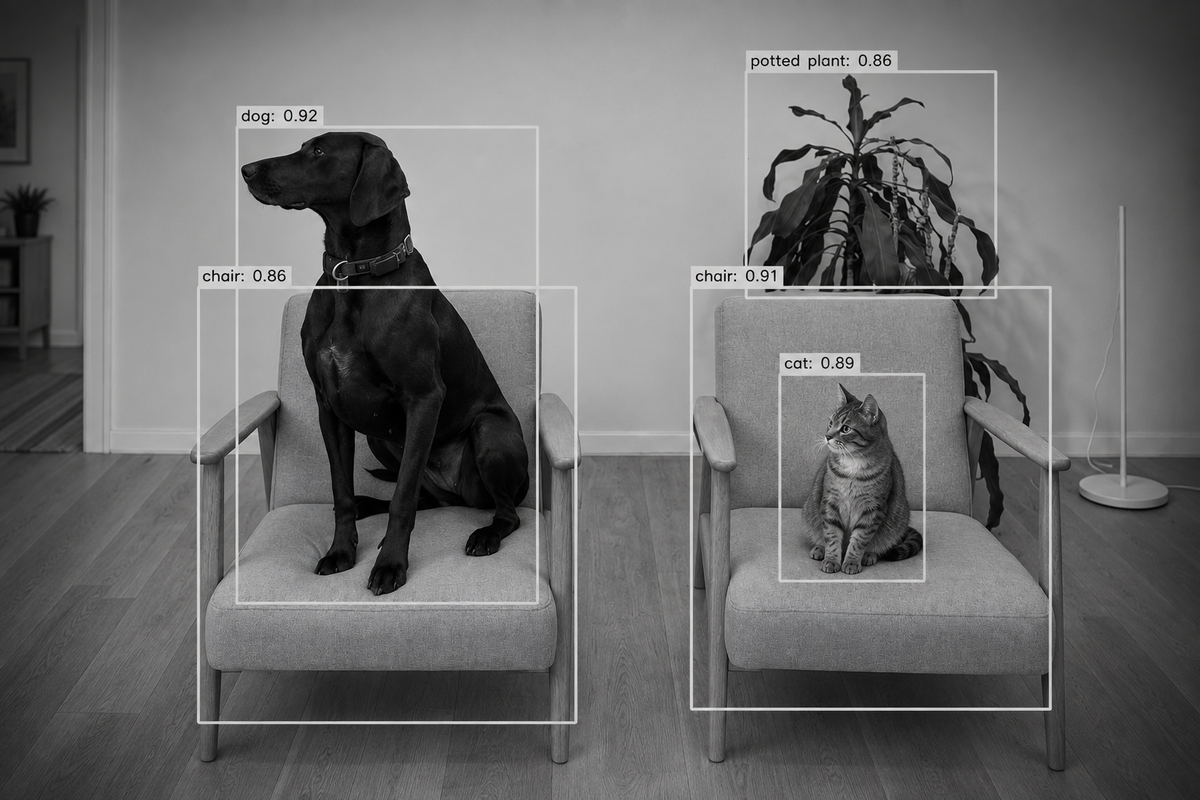
Computer vision spans a wide set of tasks: object detection identifies and localises items in an image; semantic segmentation labels every pixel by class; instance segmentation separates individual objects; and action recognition interprets human motion over time.

Modern approaches rely on deep learning architectures - convolutional neural networks (CNNs) for spatial feature extraction and vision transformers (ViTs) for global context modelling. Detection transformers such as RT-DETR have reached real-time performance while remaining fully open-source.

In production, computer vision systems must handle variable lighting, occlusion, and domain shift. Robust deployment requires continuous monitoring, re-training loops, and hardware-aware optimisation - particularly when running inference on edge devices or inside GPU-accelerated API pipelines.

Datameister applies computer vision across industrial inspection, medical imaging, sports analytics, and robotics - from single-camera tracking to multi-sensor fusion with LiDAR and depth cameras.

Related Capabilities

Computer VisionPhysical AI
See All Research Tracks

From the Blog

Why DETRs are replacing YOLOs for real-time object detection

Detection Transformers (DETRs) have matured into real-time capable object detectors, rivaling YOLOs in both speed and accuracy. Despite early challenges, advancements like deformable attention, denoising training, and top-k query selection paved the way for the first real-time Detection Transformer RT-DETR, introduced by a team of Baidu researchers in 2024. Recent innovations like D-Fine’s fine-grained localization and DEIMv2’s foundation-model backbones push accuracy even further. Additionally, all DETR models and weights are released under the permissive Apache 2.0 License, enabling free use and commercial adaptation. At Datameister, we integrate these cutting-edge models into our vision library for high-performance, adaptable, and production-ready detection systems for complex, specific problems.


Datameister @ECCV 2024: Building a foundation

Datameister's presence at ECCV 2024 in Milan was a deep dive into the latest advancements in Computer Vision. This blogpost explores groundbreaking techniques like 3D Gaussian Splatting and its enhancements, such as WildGaussians and Gaussian Frosting, showcasing their potential to revolutionize real-time rendering and scene representation.